
The March 2026 rules changed the landscape. We cut through who can buy, what is easier, and where the restrictions still bite.
Q Has New Zealand actually opened the door to foreign property buyers?
Partly. The door is wider, but it is not wide open. The March 2026 reforms did not remove Overseas Investment Act screening; they changed how many non residential investments are assessed. For significant business assets and sensitive land other than farm land and residential land, the previous national interest, benefit to New Zealand and investor tests have been consolidated into a single national interest pathway.
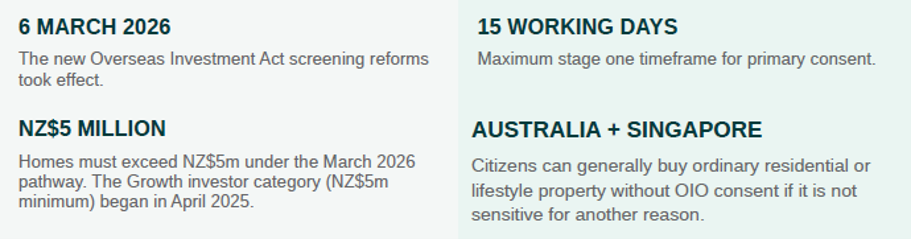
The first stage now operates much more like a risk screen. If LINZ is satisfied a fuller national interest assessment is not required, consent can be granted at that point.
That is the practical change: lower risk commercial transactions can be materially faster and more predictable than under the former regime.
Q Where does the change matter most?
Commercial property and significant business assets are where the reform has the greatest practical impact. A commercial office building, industrial site or logistics asset is not automatically sensitive simply because the purchaser is overseas. The land must first fall within one of the statutory sensitive land categories. If it is sensitive for a non residential reason, the new primary consent pathway may be available.
The pathway also applies to significant business assets (usually over NZ$100 million, subject to exceptions). Stage one allows 15 working days after payment and receipt of required information; stage two may add 55 working days. LINZ aims to assess most stage one applications in about five working days of regulator time.
Q So what still has the handbrake on?
Farm land, most residential land and fishing quota. Those categories retain separate consent pathways. For example, an acquisition involving more than five hectares of farm land will usually continue to require the farm land benefit test. Residential development also has its own pathways and conditions. A commercially attractive project does not become eligible for the new primary consent pathway simply because the investor is bringing substantial capital.
Q Can an overseas investor now buy a New Zealand home?
From March 2026, holders of an Active Investor Plus, Investor 1 or Investor 2 residence class visa can seek consent to buy or build one high value home. Investor 1 and 2 visas are closed to new applicants. The pathway covers an existing home with an agreed land-and-fixtures price over NZ$5 million, or land and qualifying new-home construction costs together exceeding NZ$5 million.
The threshold includes GST, if any, but excludes chattels. The land must not be otherwise sensitive; a pre-consent agreement must be expressly conditional on Overseas Investment Act consent. For this home pathway, the statutory assessment timeframe is 15 working days, although LINZ aims to assess most qualifying applications within five working days.
Q Does buying the NZ$5 million home satisfy the Active Investor Plus investment requirement?
No. This is one of the most important distinctions for internationally mobile families. Under the current settings, the Growth category requires at least NZ$5 million to be invested in acceptable New Zealand investments for 36 months. The Balanced category requires at least NZ$10 million for 60 months and permits a broader range of acceptable investments.
A home acquired for the investor's personal use is not an acceptable Active Investor Plus investment. An investor could therefore invest NZ$5 million under the Growth category and separately acquire a NZ$6 million residence. The transactions serve different legal and commercial purposes and need to be structured separately.
Q Why are Australian and Singaporean buyers different?
Australian and Singaporean citizens have a materially more favourable position for ordinary residential property because of New Zealand's international agreement obligations.
They can generally acquire residential or lifestyle land without OIO consent even if they are not ordinarily resident in New Zealand, provided the land is not sensitive for another reason. Australian or Singaporean permanent residents who are not citizens must be ordinarily resident in New Zealand to rely on the equivalent exemption.
In practical terms, an Australian or Singaporean citizen does not need an Active Investor Plus Visa simply to gain access to a NZ$5 million home. In many cases the citizenship exemption already permits the acquisition of ordinary residential or lifestyle property without a minimum purchase price.
Q What should advisers tell clients before they sign anything?
Structure first. Sign second.
Identify the investor: citizenship, residence status, ownership chain, control rights and any foreign government connection. Identify the asset: ordinary commercial property, sensitive land, farm land, residential land, a significant business asset or a strategically important business. Then decide whether the investment is being made directly or through a company, limited partnership or fund.
If residence is also an objective, the Active Investor Plus rules should be mapped against the investment at the same time. Tax, financing, governance, exit rights and the investor's home country requirements should also be considered before capital is committed. Treating immigration, OIA, financial markets, tax and property advice as separate sequential exercises is where avoidable problems tend to arise.
Q Will the election change the rules again?
New Zealand voted on 7 November, but the next government is not yet settled. Official results are due on 27 November; coalition negotiations could take longer. The March reforms remain law in the meantime. If the current coalition loses office, the NZ$5 million home exception could be revisited, given objections voiced by Labour and Green representatives. Whether the door narrows, and how quickly, remains uncertain. Watch this space.